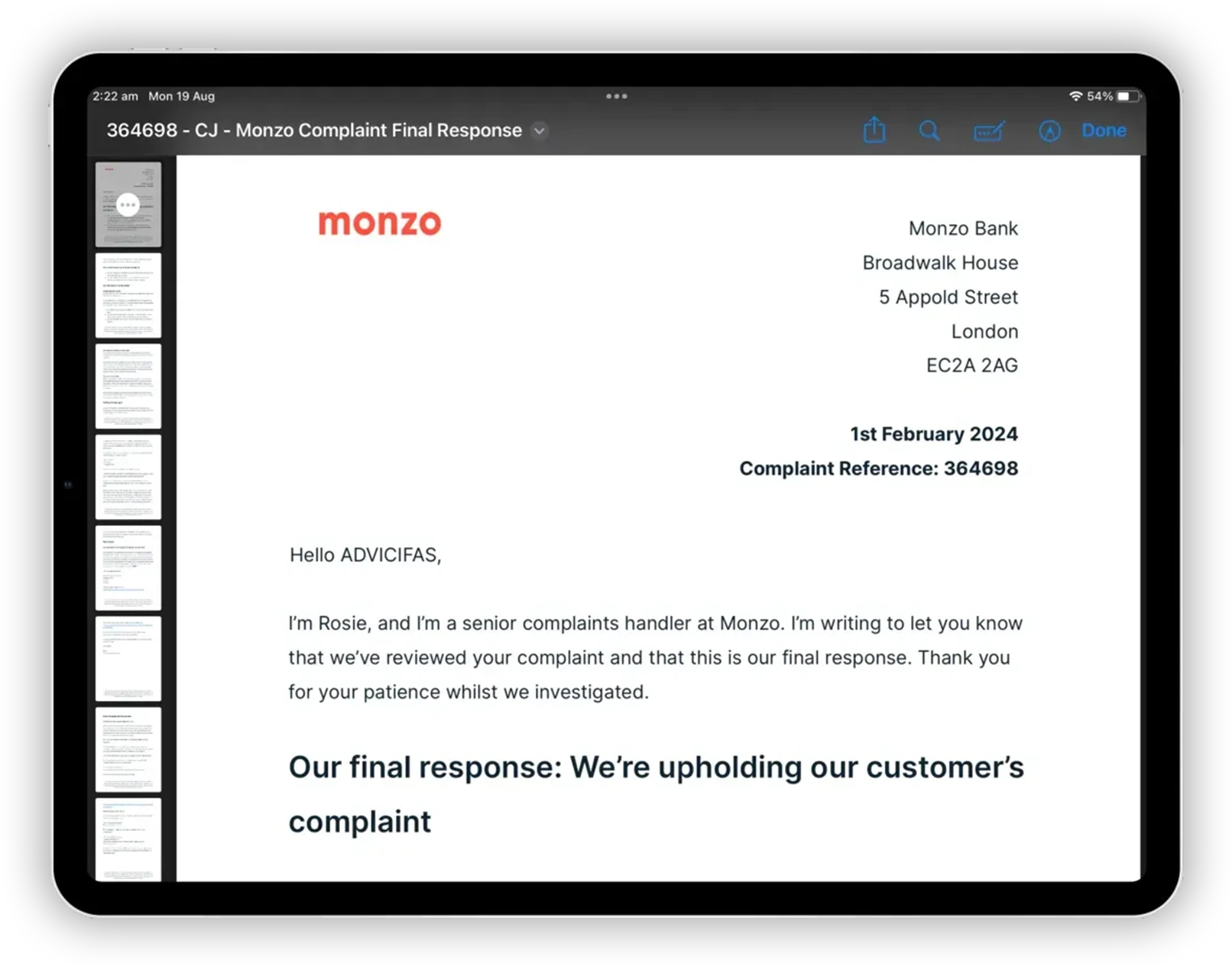
Every letter type serves a specific purpose in your challenge. You don't choose which type to generate; your roadmap determines what's needed based on where your case is and what's happened. Each letter is built from your complete case context.
Letters to the institution
Formal complaint
Your first challenge. Demands removal of the marker, citing the specific legal grounds: CIFAS Principle 4, UK GDPR, and any procedural failures identified in your case. This is where the challenge begins.
Counter response
Sent after the institution rejects your complaint. The system analyses their response for weaknesses, extracts their exact quotes, and builds a letter that dismantles their reasoning point by point. Counter responses are created automatically when a rejection is received; see Response outcomes explained.
Chaser
A follow-up when the institution hasn't responded. References the unanswered letter by date and type, cites the time elapsed, and demands a reply. Created automatically when the response is overdue.
SAR (Institution)
A Subject Access Request demanding all personal data the institution holds on you. This forces disclosure of internal investigation notes, case handler comments, and decision records, material that often contradicts their public position. The system may send a standalone SAR or embed the demand within another letter. When the response arrives, it's analysed forensically.
GDPR data challenge
Invokes your rights under UK GDPR Articles 16 and 17, the right to rectification and the right to erasure. Argues that the marker constitutes inaccurate personal data and demands correction or deletion. May also invoke Article 21 (right to object to processing).
Rebuttal
An evidence-based counter-argument. Submits specific evidence that contradicts the grounds for the marker, building the argument around what your evidence shows.
Compensation claim
Claims damages for the harm caused by a wrongful marker: financial loss, employment impact, housing impact, mental health impact, and relationship impact. Built from the impact data you've recorded during your case. Quantifies the specific harm and cites the legal basis for damages.
Information response
Sent when the institution requests information from you (identity verification, transaction details, explanations). The system analyses what they've asked for, helps you determine what to provide, what to push back on, and what to refuse. It then compiles your responses into a professional letter. The system also detects repeat requests.
Letters to external bodies
CIFAS direct challenge
Sent directly to CIFAS, bypassing the institution entirely. Challenges the marker through CIFAS's own review process. Includes the full case history and legal arguments.
Financial Ombudsman referral
Escalates the complaint to the Financial Ombudsman Service for a binding decision. Includes the complete correspondence history: every letter sent, every response received, every deadline missed, every GDPR breach documented. The Ombudsman's decision is binding on the institution.
ICO referral
Files a data protection complaint with the Information Commissioner's Office. Built from documented GDPR breaches: each one cited with the specific article, date, and evidence.
MP letter
A letter to your Member of Parliament requesting parliamentary pressure on the institution. Used as an additional pressure mechanism alongside formal escalation routes.
Other content
SAR (CIFAS)
A Subject Access Request sent directly to CIFAS, requesting your full CIFAS file and the filing evidence the institution submitted. This is separate from the institution SAR and can reveal what the institution told CIFAS vs what they told you.
Social media posts
When your roadmap includes a social media pressure step, the system generates content for public platforms targeting the institution. Social media content is exempt from your writing style; it uses a format appropriate for public platforms.
All letter types are included in your subscription. There are no per-letter charges or per-type fees. One subscription covers every letter type across all your cases.
How the system chooses
You don't pick the letter type. Your roadmap determines which type is needed based on:
- Where your case is: early cases start with formal complaints, later cases escalate to FOS/ICO
- What the institution did: rejections trigger counter responses, silence triggers chasers, information requests trigger info responses
- What's available: the system manages which escalation routes are appropriate based on your case timeline
- Your case intelligence: institution patterns and case analysis influence which types are strategically strongest
Every letter type uses the same generation pipeline: your full case context, institution intelligence, writing style, evidence, and breach records all feed in.