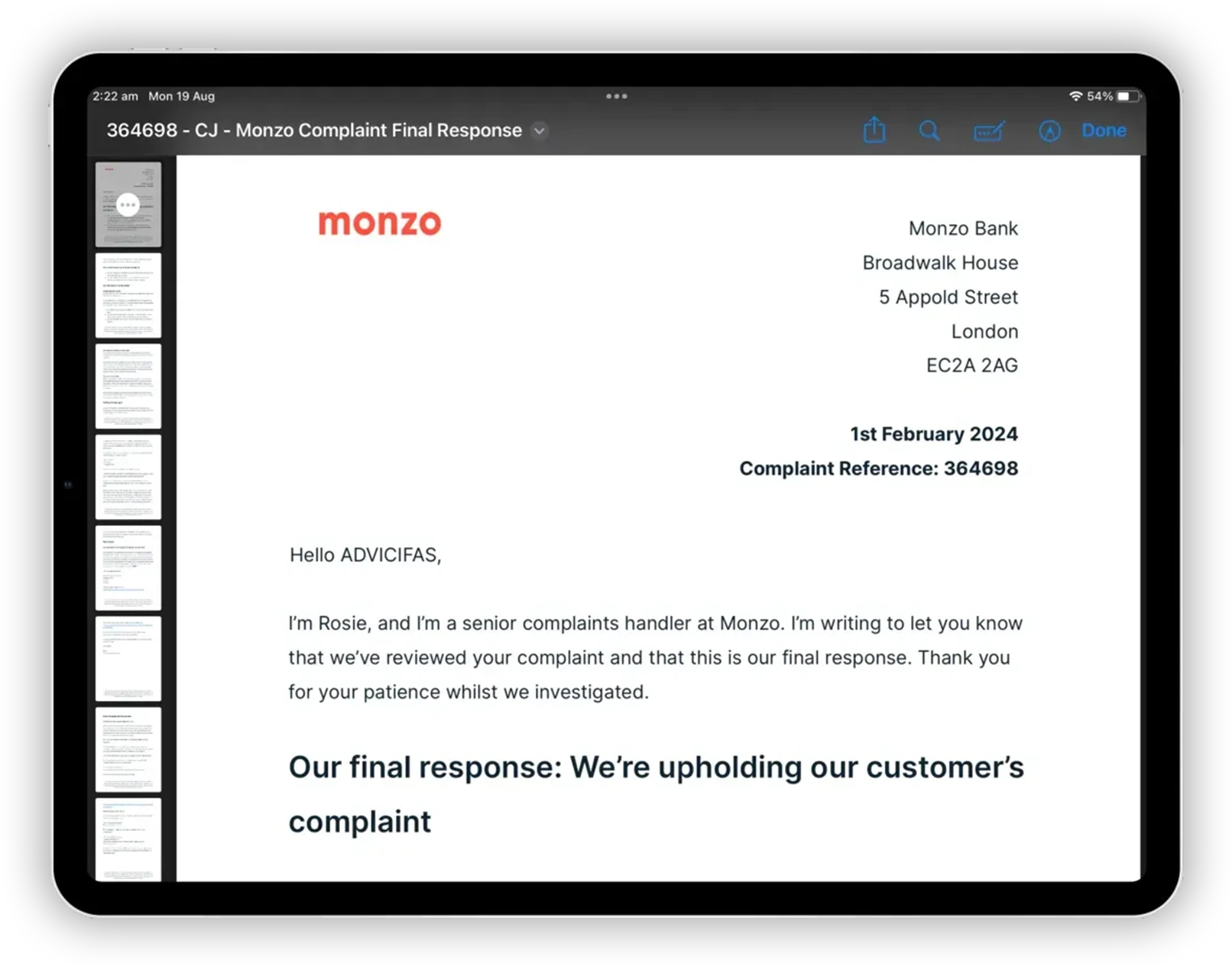
You don't need to tell the system which evidence is helpful and which isn't. When you upload a document, the system reads it, determines what it shows, rates it, and decides how to use it in your letters, all automatically.
How to upload evidence
Evidence upload steps appear in your roadmap when the system determines your case would benefit from supporting documents. You can upload:
- Documents: PDF, Word (.doc, .docx), text files, email files (.eml, .msg)
- Images: JPG, PNG, WebP (screenshots of emails, photos of letters)
- Multiple files at once: up to 10 files per upload session
- Maximum 20MB per file
You can also paste text directly if you don't have a file, for example, copying an email from your inbox.
What happens after you upload
The moment you upload a document, the system analyses it automatically:
- The document is analysed: how it's analysed depends on the file type:
- Images (JPG, PNG, WebP, HEIC): the system sees the image visually. A photo of a handwritten letter, a screenshot of a chat conversation, a scanned document with stamps and signatures: the system reads and interprets the visual content directly, not just extracted text.
- PDFs: text is extracted where available. For scanned or image-only PDFs, the system renders each page as an image and analyses them visually, so even PDFs without selectable text are fully processed.
- Office documents (Word, Excel, PowerPoint, RTF, OpenDocument, .eml): converted and then processed through the same pipeline.
- Findings are extracted: the system identifies what the document shows that's relevant to your case
- A rating is assigned: "use" or "don't use" (see below)
- A reasoning is generated: explaining why the document was rated the way it was
- Your case intelligence is updated: the findings feed into your case analysis and future letters
If the analysis uncovers observations that need confirming (for example, a date or detail the system wants you to verify), a clarification step is created automatically in your roadmap.
The rating system
Every document gets one of two ratings:
- Use: the document supports your case. It may contradict the institution's position, prove you cooperated, show the impact of the marker, or demonstrate procedural failures. Documents rated "use" are referenced in your letters.
- Don't use: the document could harm your case. It may contain admissions, contradict your account, or be irrelevant. Documents rated "don't use" are excluded entirely from all letters; the system treats them as if they don't exist.
The system is protective when rating. If there's any doubt about whether a document helps or harms your case, it defaults to "use". The bias is always in your favour.
What counts as evidence
The kinds of documents that strengthen your case:
- Communication with the institution: emails, letters, chat logs showing you reported the issue or cooperated
- Transaction records: bank statements, payment receipts, or transaction history that supports your account
- Proof of impact: mortgage refusal letters, job withdrawal emails, credit application declines, GP letters about mental health impact
- Timeline evidence: anything that establishes the sequence of events (when you reported, when they acted, when the marker was filed)
- Police or fraud reports: crime reference numbers, Action Fraud confirmations
- Previous correspondence: if you complained before joining, upload the letters you sent and any responses received
How evidence appears in your letters
The system handles evidence referencing automatically:
- "Use" documents are referenced: described in the letter with what they show, stated as "held and available upon request".
- Specific findings are cited: the strongest findings from each document are woven into the legal arguments.
- "Don't use" documents are completely excluded: not mentioned, not referenced, not alluded to. The letter reads as if they don't exist.
- Unanalysed documents are held back: if a document hasn't been analysed yet, it's not referenced in any letter until the analysis is complete.
You don't choose which evidence goes into which letter. The system selects the right evidence for each letter type automatically based on what's most relevant to the argument being made.
Findings and severity
Each document's analysis includes specific findings: what the document shows that's relevant to your case. Each finding has a severity level:
- Critical: directly proves your position or demonstrates a clear institutional error
- Strong: strongly supports your case
- Neutral: contextual information, useful for background
- Weak: minor supporting point
Higher-severity findings are prioritised in letter arguments. You can see all findings for each document in the Evidence tab on your case page.
Viewing your evidence
The Evidence tab on your case page shows every document you've uploaded with:
- Rating badge: green for "use", red for "don't use", grey for unrated
- Summary: what the document is and what it shows
- Findings table: each finding with its severity
- Rating reasoning: why the system rated it the way it did
- File details: name, size, upload date
You don't need to have evidence to challenge your marker. Many successful challenges are built entirely on legal arguments: the institution's burden of proof, GDPR rights, and procedural failures. Evidence strengthens the case but isn't always required.