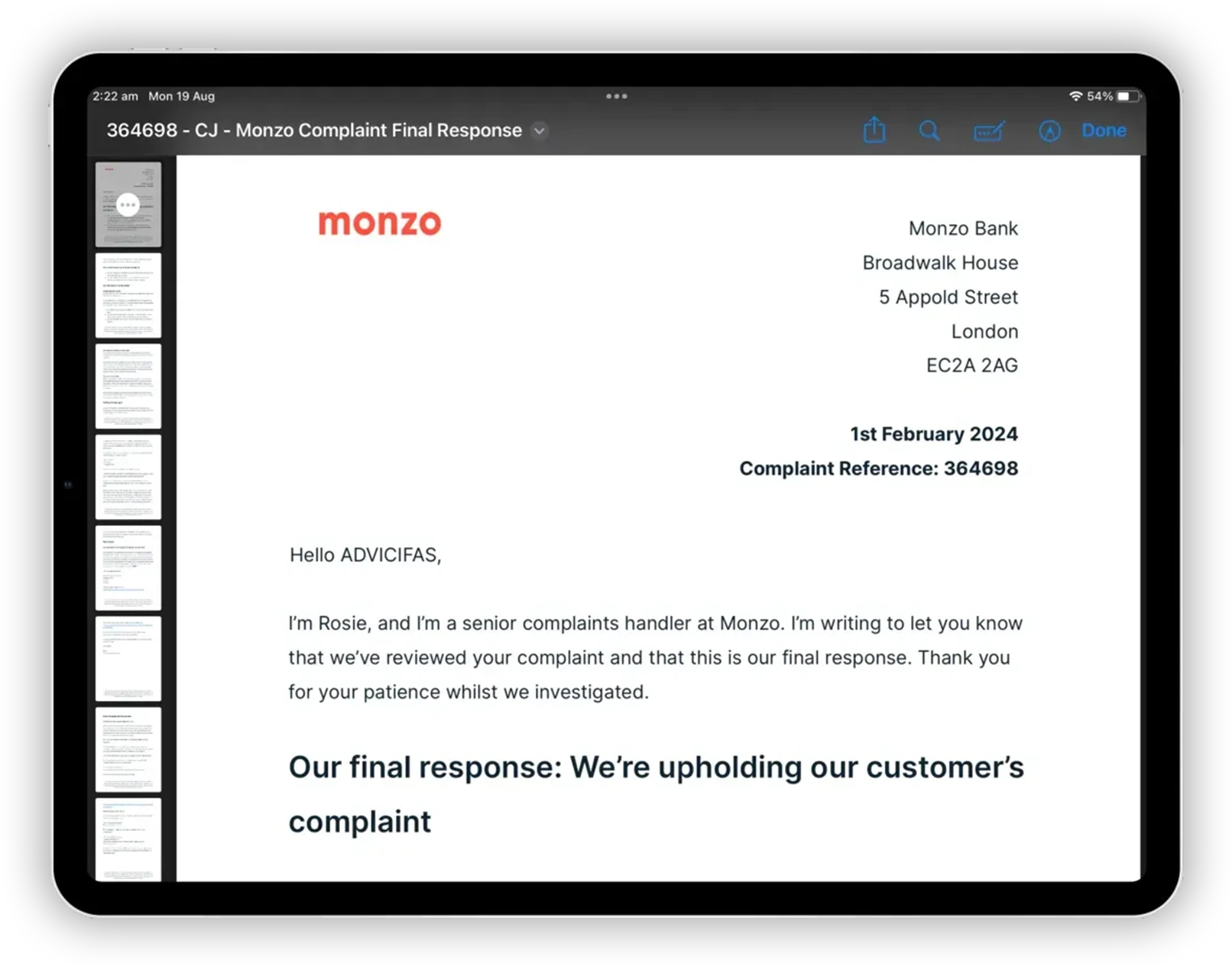
When your institution responds to your complaint, SAR request, or any other correspondence, the system needs to see their reply to build your next step.
How to upload a response
After you send a letter, the system creates an "Upload their reply" step in your roadmap. When the institution responds (by email, letter, or through their complaints portal), upload it here.
Open the upload step in your roadmap and either:
- Upload a file: PDF, Word, Excel, PowerPoint, RTF, OpenDocument, email files (.eml), or images (JPG, PNG, GIF, WebP). Max 20MB.
- Paste the text: if the response was an email, you can paste the content directly.
Upload the response as soon as you receive it. The sooner it's in the system, the sooner your next step is ready.
If the response is a password-protected PDF, the system will attempt to unlock it automatically. If it can't, you'll be asked to enter the password.
What happens next
Whether the response was detected automatically or uploaded manually, the same process runs. Everything below happens automatically; you don't need to do anything:
- The response is analysed: the system reads the full response, determines the institution's position, extracts direct quotes, identifies weaknesses in their argument, and finds regulatory failures
- An outcome is determined: see Response outcomes explained for what each outcome means
- GDPR breaches are recorded: if the response reveals any GDPR violations (missed deadlines, incomplete SAR, no legitimate interest assessment), they're logged and will be cited in future letters
- Your next step is created: based on the outcome:
- If they rejected your complaint, a counter response step appears
- If they partially conceded, a counter response step appears targeting what they didn't concede
- If they removed the marker, a confirmation step appears
- If they asked for information, an info request step appears at the top of your roadmap
- Active chasers are cancelled: if you had a pending chaser step, it's removed since they've now responded
- Your case is re-analysed: the system refreshes your entire case intelligence with the new response data
You don't choose what happens next. The system determines the correct next step based on what the institution said. Your roadmap updates in real time.
What the system extracts
From every institution response, the system extracts:
- Their position: what they decided and why
- Direct quotes: their exact words, especially admissions, weak reasoning, or refusals that can be used against them
- Weaknesses: gaps in their logic, contradictions, unsupported claims
- Rebuttal points: concrete counter-arguments the system will use in your next letter
- Regulatory failures: where they didn't follow proper procedure (incomplete Final Response, no legitimate interest assessment, failure to address your specific points)
- GDPR breaches: specific articles breached, with the evidence from their own response
All of this feeds directly into your next letter. The system quotes their own words back at them and dismantles their reasoning point by point. See How letters are generated for the full picture.
Multiple responses
If your institution sends multiple responses (for example, a holding response followed by a Final Response), upload each one as you receive it. The system analyses each individually and keeps the full history. Every response strengthens your case; even a rejection gives the system ammunition for the next round.
What if they don't respond?
If the institution doesn't respond within the statutory timeframe, the system creates a chaser step automatically. You don't need to track deadlines; the system does it for you. See Automatic chasers.
Every missed deadline is also recorded as a GDPR breach and cited in future escalation letters.
Connecting your email
Whenever you receive a response (whether by email, post, or through a complaints portal), upload it to your case so the system can analyse it and plan your next move.