Can employers see CIFAS markers?
Yes, but not all of them. A CIFAS marker is not visible on a standard credit check, and it does not appear on a DBS check. The marker sits on the CIFAS National Fraud Database, a separate system that is only accessible to CIFAS member organisations.
An employer can see your marker if they are a direct CIFAS member, or if they use a pre-employment screening company that checks the CIFAS database as part of its vetting process. As of 2026, CIFAS has over 775 member organisations, and a growing number of them are employers, not just financial institutions.
If you are not sure what a CIFAS marker is or how one ends up on your record, read our complete guide to CIFAS markers.
A CIFAS marker is not a criminal conviction. It is a unilateral fraud allegation recorded by a single institution, with no hearing, no court involvement, and no independent verification at the point of filing. This distinction matters when assessing your rights in employment contexts.
Which industries check CIFAS?
Not every employer runs a CIFAS check. The database is most commonly accessed in industries where employees handle money, sensitive data, or hold positions of trust. The following sectors routinely check:
Financial services
Banks, building societies, insurance companies, investment firms, and payment providers. Almost every FCA-regulated employer is a CIFAS member or uses a screening service that checks CIFAS. If you are applying for any role at a bank, from branch staff to IT, expect your name to be run through the National Fraud Database.
Government and civil service
Many central government departments are CIFAS members. Roles requiring Security Check (SC) or Developed Vetting (DV) clearance involve checks against the fraud database as part of the vetting process. HMRC, DWP, and the Home Office all have access to CIFAS data.
Police and law enforcement
Police forces conduct extensive vetting. A CIFAS marker will surface during non-police personnel vetting (NPPV) and police personnel vetting (PPV). It does not automatically disqualify you, but it will trigger additional scrutiny and may result in vetting failure depending on the marker type and circumstances.
NHS and healthcare
Certain NHS trusts and healthcare organisations are CIFAS members. Roles involving financial responsibility, procurement, or access to patient data may include a CIFAS check. This is not universal across the NHS; it depends on the specific trust and the role.
Telecoms and utilities
Major telecoms providers (BT, Vodafone, O2, Three) are CIFAS members. Internal roles (particularly those in fraud, finance, or customer service with account access) may trigger a check. The same applies to energy companies and utility providers that are CIFAS members.
Retail and e-commerce
Large retailers with financial services arms (e.g., Tesco Bank, Sainsbury's Bank) check CIFAS for roles connected to their banking operations. Standard shop-floor retail roles typically do not involve a CIFAS check.
Which pre-employment screening companies check CIFAS?
Even employers that are not direct CIFAS members may access the database through third-party screening services. The following are known to include CIFAS checks in their employment screening packages:
- Experian Employment Check: Experian offers employer-grade screening that can include a CIFAS database check alongside credit history and address verification.
- TransUnion (formerly Callcredit): TransUnion provides employment screening services to regulated industries, and can include CIFAS data in their reports.
- Veremark: A digital background-checking platform used by fintechs and tech companies. Can include CIFAS checks as part of financial probity screening.
- Sterling: Offers comprehensive pre-employment screening including fraud database checks for UK-based roles in financial services.
- HireRight: Used by large corporates and regulated employers; CIFAS checks can be included in enhanced financial screening packages.
If you are applying for a role in financial services, government, or any regulated industry, assume the screening will include a CIFAS check unless you have evidence to the contrary.
Do you have to disclose a CIFAS marker?
No. There is no legal obligation in the UK to proactively disclose a CIFAS marker to an employer. A CIFAS marker is not a criminal conviction, not a caution, and not a spent or unspent offence under the Rehabilitation of Offenders Act 1974. It is a private-sector database entry.
However, if an employer directly asks you, in an application form or interview, whether you have ever been the subject of a fraud investigation, fraud marker, or fraud prevention record, you have a practical choice to make. Lying on an application form can be grounds for dismissal if discovered later (gross misconduct for dishonesty). But the question itself may not be lawful in all circumstances, particularly if it is used to discriminate.
There is a critical distinction between being asked "Have you ever been convicted of fraud?" (which you can answer "no" if you haven't) and "Have you ever had a fraud marker recorded against you?" The first is about criminal convictions. The second is about a private database entry that you may not have even known about.
Under the Data Protection Act 2018 and UK GDPR, an employer who accesses your CIFAS data must have a lawful basis for doing so and must inform you that this check is being carried out. If you were never told a CIFAS check would be performed, the employer may have breached data protection law.
What happens if a job offer is withdrawn because of a CIFAS marker?
If you receive a conditional job offer that is withdrawn after a pre-employment screening reveals a CIFAS marker, the employer must comply with several legal requirements:
Data protection rights
Under the Data Protection Act 2018, you have the right to know what data was used in the decision, who provided it, and the logic behind the decision. If the employer relied on your CIFAS record, they must tell you. You can submit a Subject Access Request (SAR) to the employer to obtain the full screening report and the basis for withdrawal.
Equality Act considerations
The Equality Act 2010 protects against discrimination on the basis of protected characteristics. A CIFAS marker is not itself a protected characteristic. However, if the marker was filed in circumstances connected to a disability (for example, a mental health condition that led to financial mismanagement), withdrawing an offer solely because of the marker could constitute indirect disability discrimination. This is a developing area of law and would depend on the specific facts.
Rehabilitation of Offenders Act
The Rehabilitation of Offenders Act 1974 governs disclosure of spent criminal convictions. Since a CIFAS marker is not a criminal conviction, this Act does not directly apply. However, the principle is important: if an employer is treating a CIFAS marker as equivalent to a criminal conviction; using it to bar you from employment in the same way; they are conflating a private-sector allegation with a court-determined finding of guilt. That conflation is worth challenging.
What to do if your offer is withdrawn
First, ask the employer in writing for the specific reason the offer was withdrawn. If they cite the CIFAS marker, ask them to explain why a private-sector fraud allegation, which has not been tested in court and which you may be actively challenging, is sufficient grounds to withdraw an offer. Second, submit a SAR to both the employer and the screening company to obtain the full data they held and processed. Third, if the marker is unjustified, challenge it for removal; a successful challenge removes the marker entirely and eliminates the issue for future applications.
Can you be fired for having a CIFAS marker?
No, not for simply having a marker. If you are already employed when a CIFAS marker is filed against you, your employer cannot lawfully dismiss you solely because a marker now exists on the fraud database. Dismissal requires a fair reason under the Employment Rights Act 1996, and the existence of a third-party database entry does not constitute misconduct, capability failure, redundancy, or any other fair reason.
However, a CIFAS marker can have practical consequences within existing employment:
- Internal moves blocked. If you apply for an internal transfer to a role that requires enhanced vetting (e.g., moving into a compliance, finance, or fraud team), the CIFAS check may surface and block the move.
- Promotions denied. Promotions into senior or regulated roles, particularly Senior Managers and Certification Regime (SM&CR) roles in financial services, require fit-and-proper assessments. A CIFAS marker can cause a fitness assessment to fail.
- Contract renewals refused. For contractors and fixed-term employees, re-screening at contract renewal may reveal a marker that was not present at initial hiring.
- Security clearance revoked. If your role requires ongoing security clearance, a CIFAS marker filed during your employment may trigger a clearance review.
If your employer discovers your CIFAS marker and subjects you to disciplinary action, demotion, or dismissal, seek employment law advice. The marker is an allegation, not a finding. Unless the underlying conduct that led to the marker is independently proven to constitute workplace misconduct, the employer's position is weak.
Special cases: civil service, police, military, and FCA-regulated roles
Civil service (SC and DV clearance)
Security Check (SC) and Developed Vetting (DV) clearance involve checks against multiple databases, including CIFAS. A fraud marker does not automatically disqualify you, but it will be raised during the vetting interview. The vetting officer will assess the circumstances: when the marker was filed, by whom, the marker type, and whether you disclosed it. Failure to disclose a marker you knew about is more damaging than the marker itself. If you are applying for a clearance role, consider challenging the marker first.
Police recruitment
Police vetting is one of the most thorough screening processes in the UK. Forces check CIFAS, the Police National Computer (PNC), the Police National Database (PND), credit files, and social media. A CIFAS marker, particularly a first-party fraud marker, is likely to result in vetting failure. Some forces have published guidance stating that applicants with active CIFAS markers will not pass vetting. Having the marker removed before applying is strongly advised.
Military
Ministry of Defence vetting for the armed forces includes financial background checks. A CIFAS marker may affect Developed Vetting or Security Check clearance required for certain specialisms. Standard recruitment for infantry and non-sensitive roles is less likely to be affected, though financial probity is assessed across all branches.
FCA-regulated roles (SM&CR)
The Senior Managers and Certification Regime requires firms to assess the fitness and propriety of anyone performing a senior management function or certification function. A CIFAS marker is directly relevant to the "honesty, integrity, and reputation" component of the fit-and-proper assessment. An active marker will almost certainly cause a fitness assessment to fail, blocking you from holding any SM&CR role at any FCA-regulated firm for the duration of the marker.
How removing the marker restores your career options
When a CIFAS marker is successfully challenged and removed, it is deleted entirely from the National Fraud Database. Not suppressed. Not annotated. Gone. There is no residual trace, no historical record accessible to CIFAS members, and no "previously had a marker" flag.
This means:
- Pre-employment screening will return clean, no CIFAS hit.
- Security clearance applications will not be flagged on the fraud database.
- SM&CR fitness assessments will not identify a fraud marker.
- Internal transfers and promotions proceed without fraud-database obstruction.
- You can apply for police, military, and civil service roles without the marker as a barrier.
You do not need to wait for the marker to expire after six years. It can be challenged at any point during its active period. If the institution that filed it cannot demonstrate, under CIFAS filing standards, that you acted with deliberate dishonesty, the marker should be removed.
Beyond employment, removal also restores access to mainstream banking, mortgages, insurance, phone contracts, and car finance. The marker is the root cause of all of these restrictions.

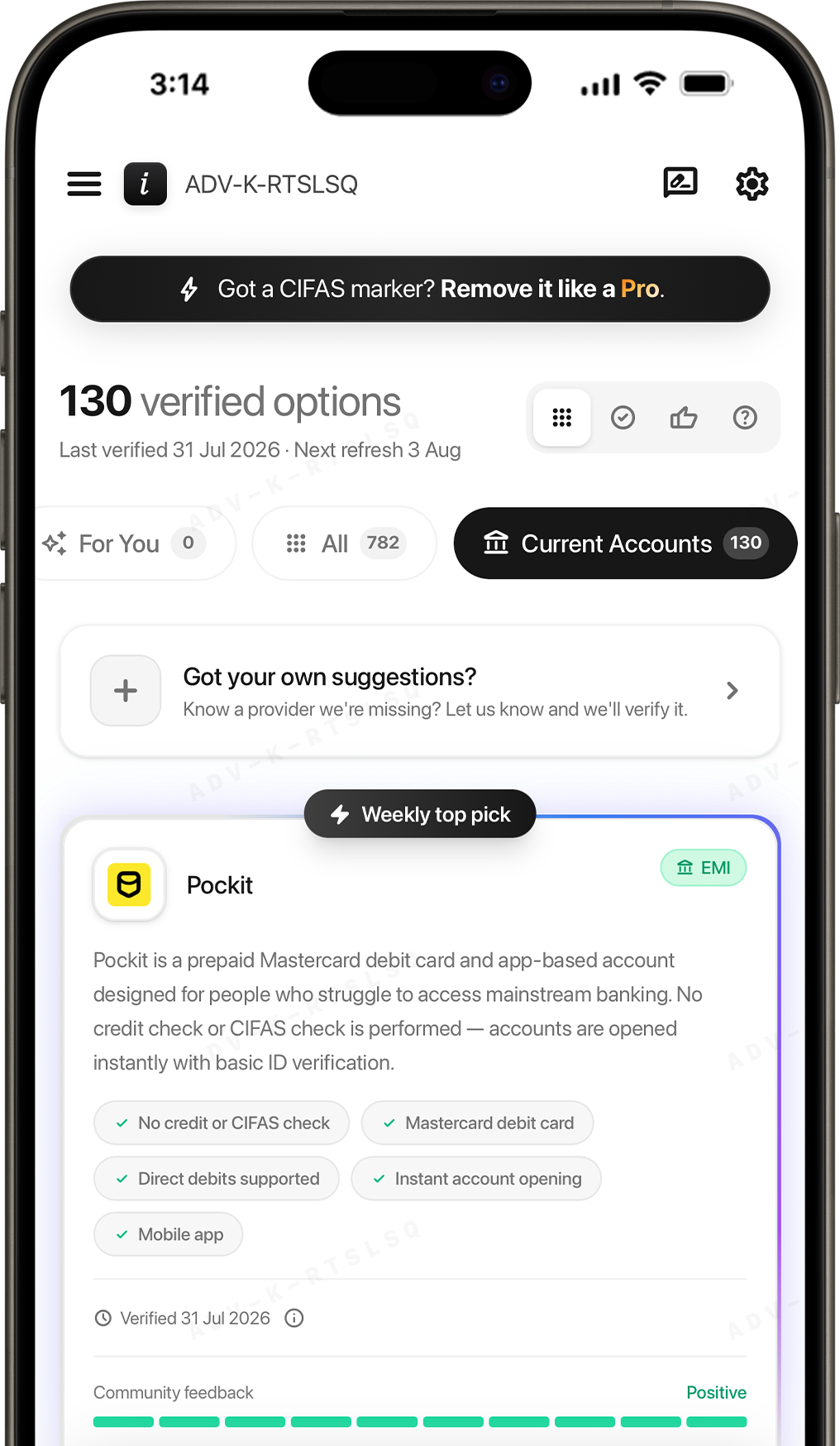
ADVICIFAS Pro Kit
Bank, Even With
a CIFAS Marker.
Stop getting rejected. We've found the ones that actually say yes. 700+ verified banks and EMIs that accept CIFAS-marked customers. £3.99/mo, cancel anytime.
How the challenge process works
Challenging a CIFAS marker is a complaints-based process, not a court case. You do not need a solicitor. The process follows a structured escalation path:
- Subject Access Request. Request your full CIFAS record from CIFAS directly, and a SAR from the institution that filed the marker. This gives you the data they used to justify the filing.
- Direct complaint to the filer. Write to the institution that filed the marker, challenging it against the CIFAS filing standards. They must prove deliberate dishonesty: suspicion, automated flags, or being a victim of fraud is not sufficient.
- CIFAS appeal. If the institution rejects your complaint, appeal to CIFAS directly. CIFAS can review whether its own filing standards were met.
- Financial Ombudsman. If CIFAS does not resolve it, refer the complaint to the Financial Ombudsman Service. The Ombudsman can order marker removal and award compensation. This service is free.
- ICO complaint. If the data processing was unlawful (for example, if the marker was filed without adequate evidence or without informing you) file a complaint with the Information Commissioner's Office.
For a detailed breakdown of every escalation level, read our CIFAS marker removal guide. If you know which institution filed your marker, check our institution-specific removal guides for targeted strategies.
ADVICIFAS Pro Kit gives you access to verified banks and EMIs that accept CIFAS-marked customers. Stop getting rejected; find verified banking options for £3.99/month, cancel anytime.