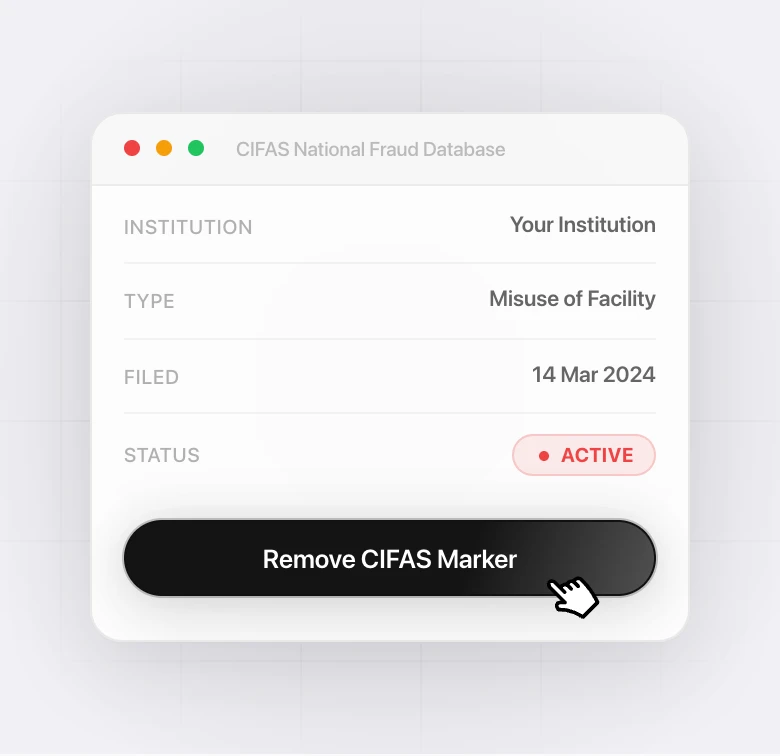
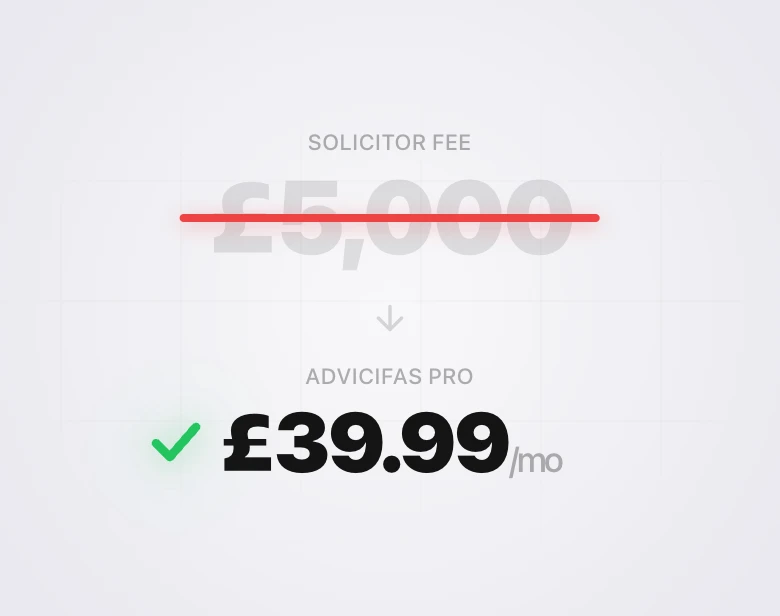
The short answer
Can you get a mortgage with an active CIFAS marker? Technically, yes. Practically, it is extremely difficult, and for most people, it will not happen while the marker remains on file.
The reason is straightforward. Every mainstream mortgage lender in the UK checks the CIFAS National Fraud Database during their application process. A fraud marker, most commonly a Category 6 "Facility Takeover Fraud" or "Application Fraud" marker, triggers an automatic decline at the underwriting stage. No manual review, no appeal, no exception. The system flags you, and the application dies.
This is not a credit score issue. You could have a perfect credit history, a large deposit, stable employment, and a low loan-to-value ratio. None of it matters if the fraud screening stage returns a CIFAS hit. The lender's system will reject the application before a human ever sees it.
There are a small number of specialist lenders who may consider applications from people with adverse credit histories, including CIFAS markers. But "may consider" is doing a lot of heavy lifting in that sentence. The options are limited, the rates are significantly higher, and the deposit requirements are punishing.
Why mortgage lenders check CIFAS
Mortgage fraud is one of the most significant financial risks a lender faces. A single fraudulent mortgage can represent hundreds of thousands of pounds in exposure. Lenders are therefore required, both by regulation and commercial self-interest, to run thorough fraud checks on every application.
Automated fraud screening
When you submit a mortgage application, the lender runs your details through multiple databases simultaneously. These include credit reference agencies (Experian, Equifax, TransUnion), the electoral roll, sanctions lists, and the CIFAS National Fraud Database. The CIFAS check is part of the standard fraud screening pipeline; it is not optional, and it is not something individual underwriters can override.
If the CIFAS check returns a marker, the application is flagged as high-risk. In most lender systems, this results in an immediate automatic decline. The applicant receives a generic rejection letter citing "internal criteria" or "unable to proceed at this time." CIFAS is never mentioned by name.
FCA regulatory obligations
The Financial Conduct Authority requires mortgage lenders to comply with the Mortgage Conduct of Business (MCOB) rules, which include obligations around responsible lending and fraud prevention. Under the Consumer Duty (introduced July 2023), firms must act to deliver good outcomes for retail customers, but this duty applies to the lender's existing and prospective customers as a whole, not to individual applicants with fraud flags.
In practice, this means lenders have a regulatory justification for declining applications where fraud indicators are present. The CIFAS marker gives them that indicator, regardless of whether the underlying allegation was justified.
Risk appetite and reputational exposure
Beyond regulation, lenders have their own commercial risk appetite. A mortgage is a long-term, high-value commitment. Approving an applicant with a fraud marker on file creates potential exposure not just to the individual loan, but to regulatory scrutiny if the application later turns out to be genuinely fraudulent. Most lenders conclude (rationally, from their perspective) that the risk is not worth taking.
This is why even lenders who specialise in adverse credit (missed payments, CCJs, IVAs, bankruptcy) often still decline applicants with active CIFAS markers. Adverse credit history and fraud allegations are treated as fundamentally different categories of risk. A missed payment suggests financial difficulty. A fraud marker suggests dishonesty. Lenders are far less willing to tolerate the latter.
What happens to your existing mortgage
If you already have a mortgage and a CIFAS marker is subsequently filed against you, the existing mortgage is safe. Your lender cannot call in the loan, increase your rate, or change the terms of your existing mortgage agreement because of a CIFAS marker.
This is a contractual matter. Your mortgage is a binding agreement. The lender agreed to lend you a specific amount at a specific rate for a specific term. A subsequent CIFAS marker does not constitute a breach of that agreement, and the lender has no contractual right to alter the terms based on it.
Your monthly payments continue as normal. Your fixed rate (if applicable) continues as agreed. Your mortgage balance reduces as scheduled. The CIFAS marker has no impact on any of this.
Where the problem starts
The problem arises when your current deal ends. If you are on a fixed rate, that rate will expire: typically after two, three, or five years. At that point, you revert to the lender's Standard Variable Rate (SVR), which is almost always significantly higher. In the current rate environment, the SVR can be 2-4 percentage points above the best available fixed rates.
On a £250,000 mortgage, the difference between a competitive fixed rate and the SVR can easily be £300-500 per month. Over the remaining term, that adds up to tens of thousands of pounds in additional interest. This is where the CIFAS marker starts costing you real money, not because the existing mortgage is affected, but because your ability to move to a better deal is blocked.
Remortgaging with a CIFAS marker
Remortgaging, switching your mortgage to a new lender to get a better rate, involves a full application process, including fraud screening. A new lender will check CIFAS, find the marker, and in almost every case, decline the application. The result is the same as applying for a new mortgage: automatic rejection.
Product transfers: the critical distinction
A product transfer is different from a remortgage. With a product transfer, you stay with your existing lender but switch to a new rate product, for example, moving from an expiring two-year fix to a new five-year fix with the same lender.
The critical difference is that product transfers often involve a lighter underwriting process. Some lenders do not re-run fraud checks for existing customers who are simply switching products. This means a product transfer may be possible even with an active CIFAS marker, depending on the lender's internal policies.
However, this is not guaranteed. Some lenders do re-run full checks for product transfers, particularly if you are changing the mortgage amount, the term, or the property. And even where a product transfer is available, the rates offered to existing customers may not be as competitive as those available on the open market.
Talk to your existing lender early
If you know your current fixed rate is approaching its end and you have an active CIFAS marker, contact your existing lender well in advance, ideally six months before the deal expires. Ask specifically whether a product transfer is available and whether it will involve a fresh CIFAS check. Do not mention the CIFAS marker unless directly asked. Simply enquire about available product transfer options for existing customers.
If the lender confirms that product transfers are processed without a fresh fraud check, you have a path to avoiding the SVR. If they do re-check, you need to plan accordingly, either by challenging the marker before the deal expires or by budgeting for the higher SVR payments.
Which lenders might still consider you
The honest answer is: very few, and none of the ones you want.
The UK mortgage market broadly divides into mainstream lenders (high street banks, building societies, and their subsidiaries) and specialist lenders (who cater to applicants with adverse credit, complex income, or non-standard circumstances). A CIFAS marker will result in an automatic decline from every mainstream lender. No exceptions.
Specialist adverse credit lenders
A small number of specialist lenders advertise that they consider applicants with "complex" or "adverse" credit histories. These lenders typically deal with:
- Missed payments and defaults
- County Court Judgements (CCJs)
- Individual Voluntary Arrangements (IVAs)
- Bankruptcy (discharged)
- Debt Management Plans (DMPs)
Some of these lenders may also consider applicants with CIFAS markers, but this is not the same as routinely accepting them. Each case is assessed individually, and the outcome depends on the type of marker, when it was filed, the lender's current risk appetite, and the overall strength of the application.
The cost of specialist lending
If you do find a specialist lender willing to consider your application, expect significant compromises:
- Interest rates: Typically 2-5 percentage points higher than mainstream rates. On a £200,000 mortgage, this can mean £400-800 per month more than a standard deal.
- Deposit requirements: Most specialist lenders require a minimum 25-40% deposit, compared to 5-10% for mainstream products. On a £300,000 property, that means putting down £75,000-120,000 rather than £15,000-30,000.
- Arrangement fees: Higher product fees, typically £1,500-2,500 or more, compared to £0-999 for mainstream products.
- Limited product range: Fewer fixed-rate options, shorter terms, and less flexibility on overpayments or portability.
The total cost difference over a typical mortgage term can easily reach six figures. A specialist mortgage is not a workaround; it is an extraordinarily expensive last resort.
First-time buyers
If you are a first-time buyer with a CIFAS marker, the situation is even more constrained. You have no existing lender to fall back on for a product transfer, no equity to provide a large deposit, and no mortgage track record to demonstrate reliability. The realistic answer for most first-time buyers with active CIFAS markers is that a mortgage is not currently achievable. The focus should be on getting the marker removed.
What mortgage brokers can and can't do
Mortgage brokers are intermediaries who search the market on your behalf and recommend suitable products. They can be invaluable for complex cases, but a CIFAS marker pushes you beyond what most brokers can handle.
Mainstream brokers
A standard mortgage broker, whether independent or tied to a network, will not be able to help you with an active CIFAS marker. Their panel of lenders will universally decline applications with fraud flags. The broker may run a "Decision in Principle" (DIP) with several lenders, all of which will come back declined. Each of those DIPs leaves a search footprint on your credit file, which can further damage your position.
If you approach a mainstream broker, be upfront about the CIFAS marker before they start running searches. A good broker will tell you honestly that they cannot help. A bad one will run multiple DIPs first, collect the fees, and then tell you.
Specialist adverse credit brokers
A small number of brokers specialise in adverse credit and have relationships with specialist lenders who may consider CIFAS-marked applicants. These brokers understand the landscape and can target the specific lenders most likely to accept your circumstances.
However, even specialist brokers will tell you that an active CIFAS marker is one of the hardest obstacles to work around. They may be able to place your application with a specialist lender, but the terms will reflect the risk: high rates, large deposit, restricted products. And many specialist brokers charge upfront fees of £500-1,000 with no guarantee of a successful outcome.
What brokers cannot do
No broker can override a CIFAS check. No broker has a "back door" into mainstream lender systems. No broker can get a CIFAS marker removed on your behalf (that is a data protection matter between you and the institution that filed the marker). Be wary of anyone who claims otherwise; the mortgage advice space has its share of people who overpromise and underdeliver.
How removing the marker changes everything
Here is the part that most guides on this topic understate: getting the CIFAS marker removed is not just one option among many; it is the only option that actually restores your access to the mortgage market.
Once a CIFAS marker is removed from the National Fraud Database, it is gone. It does not leave a residual trace. It does not appear as "previously marked" or "removed after challenge." The database entry is deleted entirely. When a lender runs a CIFAS check on your application, it returns clean.
This means that after removal, you are back to being assessed on the same basis as any other applicant. Your credit score, your income, your deposit, your employment history; all the factors that mortgage lenders actually weigh when making lending decisions. The fraud flag that was overriding all of those factors is gone.
The financial impact of removal
Consider the numbers. If the CIFAS marker forces you onto the SVR rather than a competitive fixed rate, you might be paying an extra £400 per month. Over two years while you wait for the marker to expire (assuming it was filed four years ago), that is £9,600 in unnecessary interest payments. Over the full six-year marker period, it can be £28,800 or more.
If the marker prevents you from buying a property at all, the cost is harder to quantify but potentially larger. Property prices in the UK have historically risen by 3-7% per year. A two-year delay on a £300,000 purchase could mean paying £18,000-42,000 more for the same property, on top of the rent you are paying in the meantime.
Removal eliminates all of this. It is not just about accessing a mortgage; it is about avoiding the compounding financial damage that the marker inflicts every month it remains active.
The banking problem too
A CIFAS marker does not just affect mortgages. It can lock you out of bank accounts, credit cards, car finance, insurance, and even employment checks. Removal addresses all of these simultaneously. It is a single action that restores your entire financial identity.

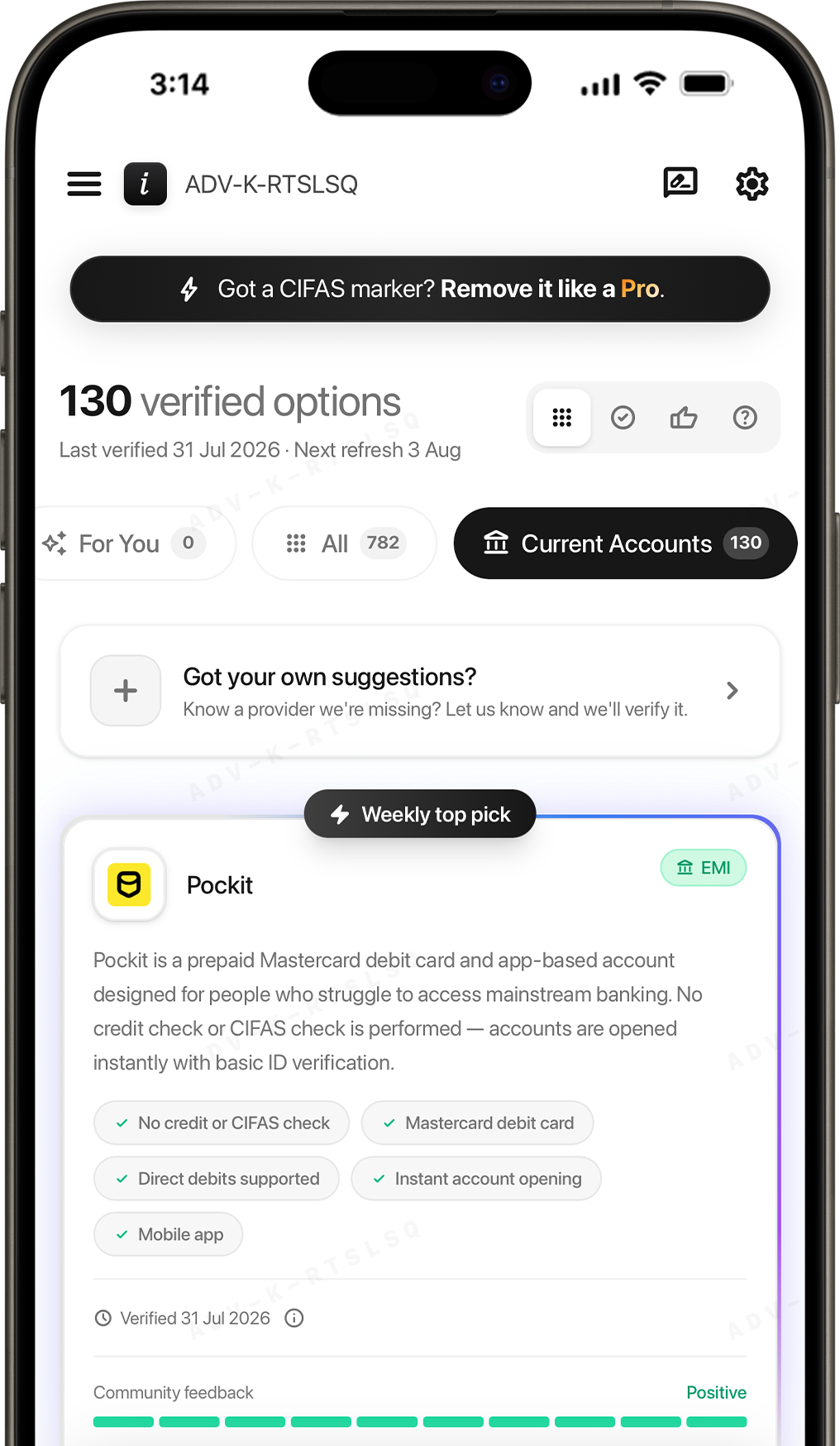
ADVICIFAS Pro Kit
Bank, Even With
a CIFAS Marker.
Stop getting rejected. We've found the ones that actually say yes. 700+ verified banks and EMIs that accept CIFAS-marked customers. £3.99/mo, cancel anytime.
The removal process
CIFAS markers can be challenged and removed at any point during their six-year lifespan. You do not have to wait for the marker to expire. The process is a data protection challenge under the UK Data Protection Act 2018 and the UK GDPR, not a legal dispute or a court case.
How it works
The challenge is directed at the institution that filed the marker, not at CIFAS itself. CIFAS is the database operator; the filing institution is the data controller responsible for ensuring the marker meets the evidential standard required by CIFAS rules. If the institution cannot demonstrate that the marker was filed correctly and proportionately, they are required to remove it.
The process typically follows these stages:
- Subject Access Request (SAR): You request all data the institution holds on you, including the CIFAS marker details and the evidence used to justify it. They have one calendar month to respond under the UK GDPR.
- Formal challenge: Using the SAR response, you build a case demonstrating why the marker fails to meet the required evidential standard. This is submitted to the institution's data protection team.
- Escalation: If the institution refuses to remove the marker, you can escalate to the Information Commissioner's Office (ICO) or the Financial Ombudsman Service (FOS) depending on the institution type.
- Resolution: The institution either removes the marker or provides a final response. If referred to FOS, the ombudsman can order removal.
The entire process can take anywhere from 4 weeks (if the institution concedes quickly) to 6-12 months (if escalation to the ombudsman is required). The critical factor is the quality of the challenge, a well-constructed, evidence-based challenge targeting specific evidential failures is far more likely to succeed than a generic complaint.
Where to start
For a comprehensive breakdown of how CIFAS markers work and the full removal process, read our complete guide to CIFAS markers. For a step-by-step walkthrough of the challenge process itself, see the CIFAS marker removal guide. For institution-specific guidance on how to challenge the marker with the particular bank, lender, or company that filed it, see our institution removal guides.
Buy-to-let mortgages and CIFAS markers
Buy-to-let (BTL) mortgages are assessed differently from residential mortgages. The primary lending criteria focus on rental yield, property value, and the borrower's experience as a landlord rather than personal income. This leads some people to assume that BTL lenders might be more lenient on CIFAS markers. They are not.
BTL lenders run the same CIFAS fraud checks as residential lenders. The automated screening process is identical. A CIFAS marker will trigger the same automatic decline regardless of whether the application is for a residential or buy-to-let mortgage.
In some respects, BTL applications with CIFAS markers are even harder to place than residential ones. The specialist adverse credit lender market for BTL is smaller, the rates are higher, and the minimum deposit requirements are steeper, often 35-50% of the property value. For most portfolio landlords with CIFAS markers, the practical advice is the same: focus on removal rather than trying to find a lender willing to overlook it.
What if you get a CIFAS marker after getting a mortgage?
If a CIFAS marker is filed against you after your mortgage has completed, the existing mortgage is not affected. The lender cannot recall the loan, change your interest rate, or alter any terms of the agreement. Your contract stands.
The impact is entirely forward-looking. When your current deal ends and you need to remortgage or arrange a product transfer, the marker becomes a problem. If you are mid-way through a five-year fix, you may have time to get the marker removed before the deal expires. If you are on a two-year fix that is about to end, the situation is more urgent.
In either case, the priority is the same: begin the challenge process as early as possible. Do not wait until your deal is about to expire; the removal process takes time, and starting early gives you the best chance of having the marker removed before you need to remortgage.
Mortgage applications in progress
If you have a mortgage application in progress and a CIFAS marker is filed during the application process, the lender will almost certainly discover it during their fraud checks and decline the application. If you have already exchanged contracts on a property purchase, this can be catastrophic; you may lose your deposit and face legal claims from the seller.
If you become aware of a CIFAS marker while a mortgage application is in progress, seek legal advice immediately regarding your contractual position on the property purchase, though be aware that solicitors are rarely the right route for the CIFAS challenge itself. Separately, begin the CIFAS challenge process without delay.
Timeline and planning
Understanding the timeline is essential for making informed decisions about your mortgage situation while a CIFAS marker is active.
Marker duration
A standard CIFAS fraud marker lasts up to six years from the date of filing. A Protective Registration, which you apply for yourself if you are at risk of identity fraud, lasts two years, and the victim markers (Victim of Impersonation and Victim of Takeover) last 13 months. During this period, the marker is visible to every CIFAS member organisation that checks the database.
Challenge timeline
The removal process itself has specific timeframes governed by data protection legislation:
- SAR response: one calendar month (UK GDPR)
- Institution response to challenge: Typically 8-12 weeks
- Financial Ombudsman: 3-9 months if escalation is required
- ICO complaint: Variable, but typically 2-6 months
Best case, a well-prepared challenge can result in removal within 4-8 weeks. Worst case, with full ombudsman escalation, the process can take up to 12 months. The quality of the initial challenge is the single biggest factor in determining which end of this range you land on.
Planning around your mortgage deal
If your fixed rate expires in 12 months and you have an active CIFAS marker, start the challenge process now. If it expires in 6 months, you are cutting it fine but removal is still possible if the challenge is strong. If it expires in 3 months or less, prioritise a product transfer with your existing lender as an interim measure while pursuing removal in parallel.
Do not assume the marker will just expire. Six years is a long time to be locked out of competitive mortgage rates, and the financial cost of waiting, as outlined above, can run into tens of thousands of pounds.